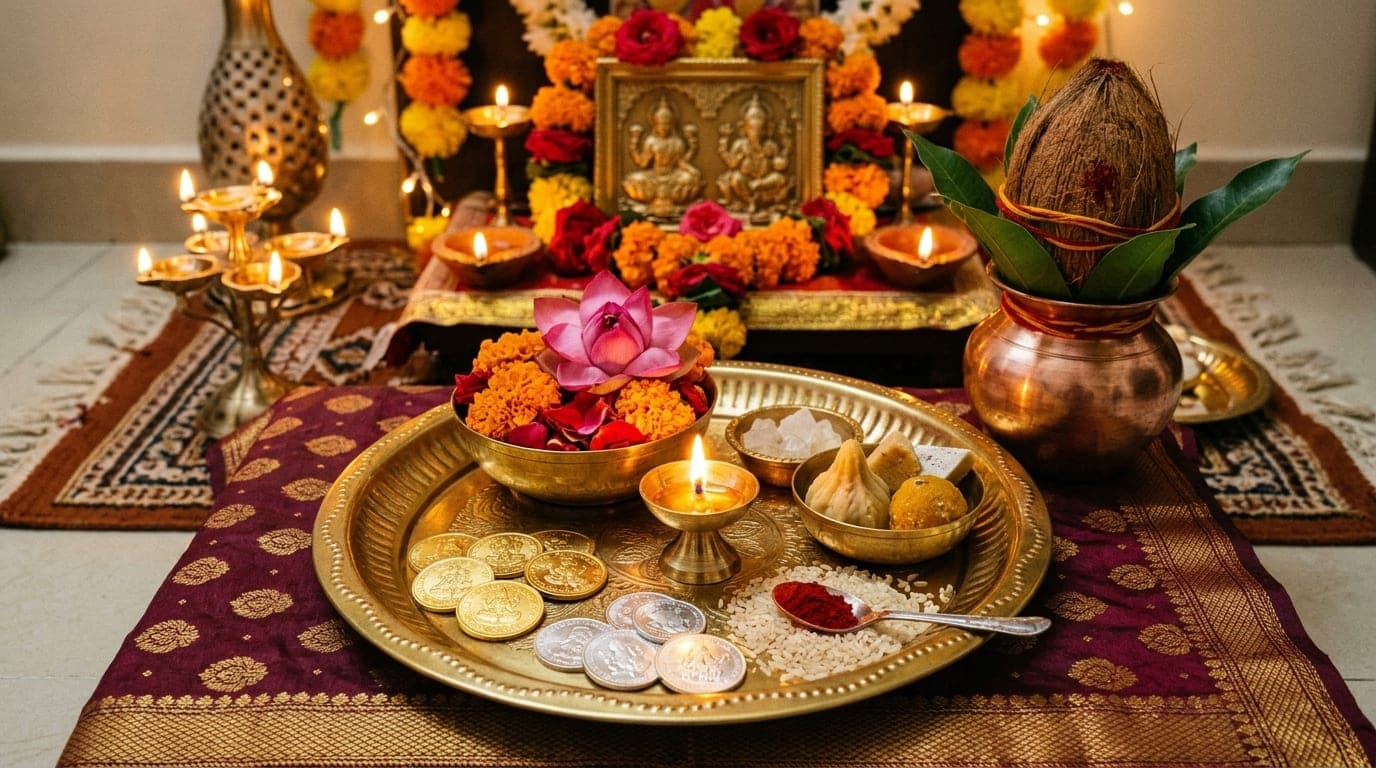
Diwali, the supreme festival of lights (Deepawali), represents the victory of spiritual illumination over ignorance, righteousness over darkness, and divine abundance over scarcity. In 2026, Diwali falls on Sunday, 8 November 2026, on the auspicious Kartik Krishna Amavasya. Across Sanatan Dharma, this holy night marks the descent of Goddess Maha Lakshmi, the cosmic provider of wealth, accompanied by Lord Maha Ganapati (the remover of obstacles) and Lord Kuber (the celestial treasurer).
For centuries, kings, merchants, and householders have sought to perform Diwali Pujan at sacred tirthas where divine energy is concentrated. Among all the pilgrimage centers in India, the holy precinct of Baba Baidyanath Jyotirlinga in Deoghar holds an extraordinary, legendary place for Diwali worship. When the wish-fulfilling Kamana Linga of Lord Shiva is worshiped alongside Goddess Maha Lakshmi on Diwali night, ancient scriptures declare that poverty, ancestral doshas, and business hurdles dissolve, bestowing everlasting peace, debt freedom, and prosperity.
1. Diwali 2026 Lakshmi Puja Shubh Muhurat & Planetary Timings
The selection of the correct muhurat is the most vital aspect of Diwali Lakshmi Pujan. According to the classical Vedic panchang, the Amavasya tithi must coincide with Pradosh Kaal (the 2 hours and 24 minutes after sunset) and, most importantly, with Sthir Lagna (a fixed astrological sign). Worshiping during a fixed ascendant ensures 'Sthir Lakshmi' or 'Achala Lakshmi'—wealth that remains permanently in your home, business, and lineage rather than fluctuating.
- Diwali Calendar Date: Sunday, 8 November 2026
- Amavasya Tithi Commences: 8 November 2026 at 06:18 AM (IST)
- Amavasya Tithi Concludes: 9 November 2026 at 04:31 AM (IST)
- Pradosh Kaal Window (Most Auspicious for Families & Grihasthas): 05:32 PM to 08:08 PM (IST)
- Vrishabha Sthir Lagna (Fixed Ascendant for Stable Wealth): 05:46 PM to 07:42 PM (IST)
- Maha Nishita Kaal Muhurat (Ideal for Sadhaks, Traders & Business Ledgers): 11:39 PM to 12:31 AM (IST)
- Simha Sthir Lagna (Midnight Fixed Sign for Tantric & Commercial Sadhana): 12:14 AM to 02:29 AM (IST, 9 Nov)
Diwali 2026 Auspicious Lakshmi Puja Muhurat & Kaal Schedule
In 2026, Diwali falls on Sunday, a day governed by Surya Dev (the Sun), symbolizing prestige, leadership, and vitality. The overlapping window of Pradosh Kaal and Vrishabha Lagna between 05:46 PM and 07:42 PM is universally recognized as the golden hour to perform your family puja, light your Akhand Deepa, and participate in Vedic sankalps.
Auspicious Day & Night Choghadiya Timings for 8 November 2026
If you are opening business accounts, worshiping office premises, or performing pujas throughout the day, refer to these auspicious Choghadiya periods:
- Morning Shubh Choghadiya: 07:54 AM to 09:16 AM (IST) — Excellent for cleaning the puja altar and setting up the deity idols.
- Afternoon Labh & Amrit Choghadiya: 01:22 PM to 04:06 PM (IST) — Ideal for business ledger preparation, buying new utensils or silver coins.
- Evening Shubh & Amrit Choghadiya: 05:28 PM to 08:44 PM (IST) — The peak period for lighting 108 ghee lamps and reciting the Shri Suktam.
- Night Labh Choghadiya: 12:02 AM to 01:40 AM (IST, 9 Nov) — Sacred window for Kuber and Kanakadhara stotra recitations.
2. The Spiritual Mystery of Baba Baidyanath Jyotirlinga on Diwali Night
Situated in Deoghar (Jharkhand), the sacred Baba Baidyanath Mandir is a rare jewel of Sanatan Dharma. It is one of the only holy places in the world that is simultaneously a revered Shiva Jyotirlinga and one of the 51 Shaktipeeths (Hardapeetha or Hridaya Shaktipeeth, where the heart of Devi Sati fell).
Lord Shiva is worshiped here as the 'Kamana Linga'—the compassionate physician (Baidyanath) who diagnoses and eradicates worldly afflictions, chronic illness, and poverty. The Shiva Purana records that when the demon king Ravana performed intense tapasya, offering nine of his heads to Lord Shiva, Mahadeva was pleased and granted him this Jyotirlinga, promising that whatever sincere wish a devotee utters before this lingam shall be fulfilled.
Why is Baba Baidyanath Dham so powerful for Lakshmi Pujan? The Skanda Purana reveals a profound secret: Goddess Lakshmi once performed intense penance worshiping Lord Shiva with one thousand blue lotus flowers to attain the eternal love and companionship of Lord Vishnu. Lord Shiva, delighted by Her single-minded devotion, blessed Her with eternal sovereignty over all celestial and terrestrial treasures. Furthermore, the temple complex features a sacred red Gathbandhan cloth tied directly between the golden vessel of Baba Baidyanath Temple and the spire of Maa Parvati Temple. Performing Lakshmi-Ganesh Puja at this divine confluence bridges the cosmic forces of Shiva (inner peace and liberation) and Shakti (material abundance and dynamic prosperity).
3. Complete & Authentic Diwali Puja Samagri Checklist
An authentic Vedic puja requires pure, unadulterated samagri arranged with devotion. Below is the itemized checklist used by our certified Tirtha Purohits, which you can also prepare at home:
- Idols & Sacred Images: Pratimas of Goddess Maha Lakshmi, Lord Maha Ganapati, Saraswati Devi, and a consecrated Kuber Yantra or Shri Yantra.
- Pavitra Kalash: A fresh brass or copper kalash filled with clean water, Gangajal, a supari (betel nut), a coin, and five fresh mango leaves (Amrapallav).
- Sacred Flora: Fresh red lotus flowers (Kamal ke phool) which are dearest to Maa Lakshmi, sacred bilva patra (belpatra) for Lord Shiva, fresh durva grass for Lord Ganesha, and marigold garlands.
- 108 Desi Ghee Diyas: 108 earthen lamps (mitti ke deepak) filled with pure A2 desi cow ghee, plus 1 large four-faced (Choumukhi) Akhand deepa.
- Panchamrit Ingredients: Fresh unboiled cow milk, thick homemade curd, pure wild forest honey, desi cow ghee, and sugar/batasha.
- Roli, Chandan & Akshat: Pure Roli, red Kumkum, Ashtagandha chandan, turmeric powder, and sacred Akshat (unbroken raw rice washed in Gangajal).
- Sacred Clothing & Janeu: New yellow cloth for Lord Ganesha, rich red silk cloth for Goddess Lakshmi, and two pure cotton Janeu threads.
- Panch Meva & Fruits: A bowl of five dry fruits (almonds, cashews, raisins, makhana, dry dates), seasonal fruits (pomegranate, custard apple, water chestnut, banana), and a whole Shriphal (sacred coconut with water).
- Maha Naivedya: Freshly prepared motichoor laddoos, mawa peda, kheer, and fresh paan ke patte (betel leaves with clove, cardamom, and supari).
- Vedic Texts: Kanakadhara Stotram, Shri Suktam from the Rigveda, Lakshmi Chalisa, and the Aarti book.
4. Step-by-Step Vedic Diwali Lakshmi-Ganesh Puja Vidhi
Whether you are chanting alongside a pandit or performing the rituals yourself, following the traditional Shodashopachara (16-step) sequence ensures your puja is completed with utmost spiritual sanctity.
- Shuddhikaran & Pavitrikaran: Clean your puja room and altar thoroughly. Sit facing East or North on an asana of wool or silk. Sprinkle Gangajal over yourself and all puja items while chanting: 'Om Apavitrah Pavitro Va Sarvavastham Gato'pi Va, Yah Smaret Pundarikaksham Sa Bahyabhyantarah Shuchih'.
- Deepa Sthapana: Light your central four-faced ghee lamp to act as the divine witness (Sakshi) of your worship. Chant 'Deepajyoti Parabrahma Deepajyotir Janardanah' and offer flower petals.
- Swasti Vachan & Mangal Shanti: Recite peace invocations invoking the blessings of the three worlds and seeking harmony across all directions.
- Mangal Kalash Sthapana: Place a clean red cloth on a wooden chauki. Make an Ashtadal lotus design with raw rice grains. Place the kalash, tie sacred kalawa (moli) around its neck, insert five mango leaves, and crown it with a coconut wrapped in red cloth.
- Shri Ganesh-Gauri Pujan: Every Hindu ritual commences with Lord Ganesha. Bathe the deity with Gangajal and Panchamrit, apply red sindoor and chandan, offer sacred Durva grass and modak, chanting 'Vakratunda Mahakaya Surya Koti Samaprabha'.
- The Sacred Gotra & Family Sankalp: Hold water, unbroken akshat, a flower petal, and a coin in your right palm. Explicitly state the Vikram Samvat year, your current location, your Gotra, your full name, and the names of your family members, dedicating this puja for debt removal, financial stability, and divine protection.
- Maha Lakshmi Avahanam & Dhyanam: Invoke Goddess Lakshmi with folded hands holding lotus flowers. Chant the Vedic Dhyana mantra: 'Namastestu Mahamaye Shreepeethe Surapoojite, Shankha Chakra Gada Haste Mahalakshmi Namostute'.
- Shodashopachara Offerings: Offer Asana, Padya (washing of feet), Arghya, Snana (bath with panchamrit and Gangajal), Vastra, Chandan, Kumkum, Akshat, fresh red lotus flowers, Dhoop, and Naivedya.
- Kanakadhara & Shri Suktam Recitation: Recite or listen attentively to the 16 verses of the Shri Suktam and Adi Shankaracharya's Kanakadhara Stotram. This is the heart of the Diwali worship.
- Kuber & Bahi-Khata Pujan: Shop owners, business proprietors, and professionals place their accounts books, laptops, or locker keys beside the deity, worshiping Lord Kuber for righteous commerce and uninterrupted cash flow.
- 108 Ghee Deep Daan: Light all 108 pure desi ghee deepaks. Place them sequentially across the mandir, main threshold, kitchen, safe locker, and tulsi plant to welcome Maha Lakshmi into every corner.
- Maha Aarti, Kshama Prarthana & Prasad Vitran: Perform the Aarti of Lord Ganesha and Goddess Lakshmi with camphor. Conclude by reciting the Kshama Prarthana ('Aavahanam Na Janami Na Janami Visarjanam...'), seeking forgiveness for any unintended ritual shortcomings, and distribute the blessed prasad among family.
5. The Spiritual Significance of 108 Desi Ghee Deep Daan
Lighting 108 lamps is not merely a symbolic decoration; it is an esoteric Vedic remedy. In Indian astrology and sacred numerology, the number 108 represents the cosmic wholeness of creation: the 12 astrological signs (Rashi) multiplied by the 9 planetary forces (Navagraha) equals 108. Furthermore, the distance between the Earth and the Sun is roughly 108 times the Sun's diameter.
When 108 pure desi cow ghee lamps are illuminated with your family sankalp on Diwali night, the sacred fire (Agni Tattva) burns away negative karmic vibrations, purges Vastu doshas, and balances the malefic influences of Rahu, Ketu, and Saturn (Shani). The pure aroma of burning cow ghee generates positive pranic energy that shields your home and business for the entire upcoming year.
6. How NRIs & Distance Devotees Can Book at Baba Baidyanath with 100% Video Proof
In today's fast-paced world, countless devotees reside far from their ancestral homes—working in metropolitan cities like Delhi, Mumbai, Bengaluru, and Hyderabad, or living abroad in the United States, United Kingdom, Canada, Australia, UAE, and Singapore. Traveling to Deoghar to perform puja on Diwali night is often logistically impossible.
VisitTemples solves this sacred challenge with absolute authenticity and transparency. Our certified Tirtha Purohits, who hail from generations of verified priests at Baba Baidyanath Jyotirlinga Dham, perform your exclusive family sankalp inside the sacred temple precinct on Diwali night.
Transparent Puja Packages & Pricing
We believe faith must be accompanied by honest, upfront pricing. Our Diwali 2026 packages include complete samagri, pandit dakshina, and video proof delivery:
- Festival Samuhik Seva (₹1,101): Your family's name and gotra are taken in the auspicious festival group sankalp at Baba Baidyanath Jyotirlinga, with 108 ghee deepaks lit and a WhatsApp video clip delivered.
- Dedicated 1-on-1 Personal Puja (₹1,501): An exclusive, individual puja performed solely for your family. The Purohit recites your names, gotra, and specific prayer, accompanied by an exclusive 2–3 minute video recording of the live sankalp.
- Dampati (Couple) Puja (₹2,101): Dedicated worship for husband and wife seeking marital harmony, child blessings, and joint financial prosperity, with special lotus offerings and personalized video proof.
- Complete Family Puja (₹3,101): A comprehensive mahapuja for up to 6 family members. Includes 108 desi ghee deepaks, special dry fruit and panchamrit bhog, belpatra offerings to Baba Baidyanath, and an HD video recording of your family sankalp.
- Exclusive Live Video Call Puja (₹5,501): Private, interactive puja where you join the Purohit live via 1-on-1 WhatsApp video call from your home anywhere in the world, participating in the sankalp in real-time.